The Wall Around AI’s Winners
William Dougall, Investment Specialist at Pengana Capital
Anthropic, OpenAI and ByteDance are collectively worth around US$2.4 trillion at their most recent institutional valuations. In AUD terms, that is close to A$3.5 trillion, exceeding the entire ASX market capitalisation of A$3.26 trillion. None of these companies feature meaningfully in any major public equity index, any broadly held ETF, or any listed equity managed fund available to Australian investors. From a portfolio construction standpoint, some of the largest companies in the world remain effectively out of reach.
The Disruption Is Already in the Portfolio
While the AI creators sit outside most investment portfolios, investors have significant exposure to the companies AI is disrupting. The enterprise software sector was one of the worst performing segments of the market in the first half of 2026. Salesforce and Adobe were both down around 40% over that period. Atlassian has lost more than 50% over the same period, and laid off 10% of its workforce in March 2026. Workday cut 8.5% of its own workforce in February 2025, explicitly redirecting resources toward AI, with a further round of cuts announced in February 2026.
The reason this repricing may be structural, rather than a cyclical dip to be bought, is that the underlying business models are under genuine pressure. Nearly all traditional enterprise software companies charge per seat, per month. AI agents replace seats, and if one agent can do the work of ten licensed users, the company selling those ten seats loses nine subscriptions. Enterprise technology budgets are shifting away from traditional software subscriptions and toward AI tooling and infrastructure.
Investors may assume that owning the hyperscalers gives them meaningful participation in AI, including through the investments many of them have made in businesses such as OpenAI and Anthropic. In reality, that participation is diluted across sprawling conglomerates and captures only a fraction of the value being created. The result is that most investors are structurally underweight AI without having made that decision deliberately.
The Creators Are Private
The companies building this economy are almost all private, and generating more value in private hands than any previous cohort before listing. Anthropic and OpenAI sit at the core of the foundation model layer. Beyond the household names, there is a deep bench of private companies building out the rest of the stack. These include businesses like Databricks in data infrastructure, Anduril and Shield AI in defence systems, Waymo and Wayve in autonomous driving, and Figure and Physical Intelligence in humanoid robotics. None are accessible through a listed share portfolio.
Anthropic is the clearest example. Its post-money valuation has moved from US$61.5 billion in March 2025 to US$965 billion in May 2026, a fifteen-fold move in fourteen months, all of it before a single share has traded publicly. That valuation is being underwritten by revenue growth that is unusual even in software. Annualised revenue moved from around US$9 billion at the end of 2025 to approximately US$47 billion by May 2026, of which roughly 80% comes from business customers. Independent third-party tracking suggests continued strong growth in the months since, though Anthropic has not disclosed updated figures. OpenAI’s post-money valuation has followed a similar trajectory, moving from US$300 billion in April 2025 to US$500 billion in October 2025 to US$852 billion by March 2026.
Anthropic post-money valuation by primary funding round, March 2025 to May 2026
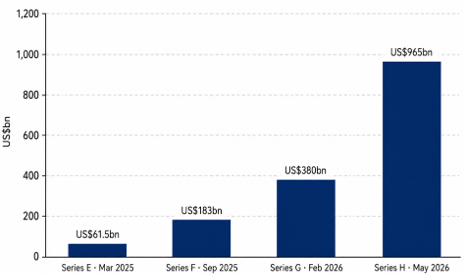
Source: Anthropic press releases, each available at anthropic.com/news.
The Series H, closed on 28 May 2026, is likely to be Anthropic’s last private round. Three days later, Anthropic confidentially filed for an IPO with the SEC and is targeting a listing as soon as October 2026. OpenAI filed a week later. Both companies are approaching listings at scales that few private companies have ever reached, with OpenAI’s advisers reportedly targeting a US$1 trillion listing valuation in early 2027. The transition from private to public markets typically carries a liquidity premium as tradable shares become accessible to a broader base of institutional and retail capital. Current index inclusion rules from providers such as Nasdaq, FTSE Russell and S&P Dow Jones can amplify that dynamic through mechanical, price-insensitive buying from passive funds following each listing. Investors positioned ahead of these listings participate in the transition from private to public markets on materially different terms to those entering through passive vehicles afterwards.
AI Private Opportunities Trust (ASX: AIX)
AIX, the AI Private Opportunities Trust, listed on the ASX on 2 July. It provides Australian investors with exposure to a targeted portfolio of 12 to 20 leading private AI companies, spanning the full ecosystem from foundation models and infrastructure through to applications. The trust is brought to market by Pengana in partnership with GCM Grosvenor, a US$91 billion global alternative asset manager with 25 years of private equity investment experience. AIX builds on the existing Pengana-GCM partnership behind the Pengana Private Equity Trust (ASX: PE1), which has been listed on the ASX since 2019. GCM’s client base is predominantly institutional, including sovereign wealth funds, insurance companies and pension plans, with strong relationships across private equity managers and a track record of securing positions in leading private AI rounds.
AIX is designed for the current cycle of private AI value creation. Rather than listing as a permanent capital vehicle, it has a self-liquidating structure with an expected seven-year life. Capital is recycled during a reinvestment period in years one and two, with both capital and profit returned to investors from year three onwards as positions are realised. Management fees fall to zero after year seven, removing any incentive to extend the trust beyond its intended purpose. The result is a listed vehicle giving Australian investors access to the leading private AI companies while the compounding is still happening in private hands.
Further information is available in the Product Disclosure Statement at theAIfund.com.au.
IMPORTANT INFORMATION AND DISCLAIMER
Pengana Investment Management Limited ACN 063 081 612, AFSL 219462 (Pengana) is the issuer of this information and units in AI Private Opportunities Trust ARSN 697 001 184 (AIX). This information is of a general nature only and has been prepared without taking into account your objectives, financial situation or needs. Before making an investment decision in respect of AIX you should consider the PDS, TMD and ASX announcements available at pengana.com/AIX and assess whether AIX is appropriate given your objectives, financial situation and needs. Neither Pengana nor any of its related entities, directors, partners or officers guarantees the performance of, or the repayment of capital, or income invested in AIX. An investment in AIX is subject to investment risk including a possible loss of income and principal invested. Past performance is not a reliable indicator of future performance, the value of investments can go up and down. There are no guarantees that an active trading market with sufficient liquidity will develop or that such a secondary market will sustain a price representative of the NAV per AIX unit. In circumstances where AIX units are suspended from the ASX, unitholders may not be able to sell their AIX units via the ASX until trading recommences.