The Great Capital Rotation: Why Tax Reform Could Be a Catalyst for A-REITs

Executive Summary
- Tax reform may redirect capital away from direct residential property. Replacing the 50% CGT discount and restricting negative gearing to new builds materially reduce the appeal of existing residential property, potentially prompting investors to redeploy into income-producing alternatives such as A-REITs.
- Select A-REITs are well-positioned to benefit. Trusts with high yields, build-to-rent exposure, long-lease commercial assets, and diversified portfolios stand to capture rotating capital, particularly those currently trading at discounts to NTA.
A-REITs have fallen out of favour over the past 6-9 months as rising bond yields and higher interest rates weighed on valuations, leaving the sector trading at deep discounts to NTA. While rate expectations appear to be nearing a plateau, the recently announced 2026-27 Federal Budget could prove to be a more powerful catalyst. As investors recognise that the proposed tax reforms may increasingly favour investing in income yielding property funds over direct residential investment, we see scope for a meaningful re-rating of the A-REIT sector and believe now is an attractive time to selectively rebuild exposure.
The most significant proposed reforms are: (1) replacing the current 50% capital gains tax (CGT) discount with an inflation-indexed cost base, subject to a minimum 30% tax on nominal capital gains; and (2) restricting negative gearing concessions to newly constructed residential properties.
While the final legislation may differ from the proposals currently under consideration, as amendments are often made during the legislative process, we believe the broader policy objective and direction of reform are unlikely to change materially.
Why Are These Changes Being Proposed?
For decades, Australians have favoured growth-oriented assets such as residential property and equities, supported by generous tax incentives. The Government’s proposed reforms seek to reshape these incentives by improving housing affordability, increasing access to home ownership for younger Australians, and reducing the disparity between the taxation of labour income and capital gains.
From 1 July 2027, the Government proposes replacing the 50% CGT discount with a system that indexes an asset’s cost base to inflation, while applying a minimum 30% tax rate on nominal capital gains. Existing property investors will be partially grandfathered, with gains accrued before 1 July 2027 continuing to qualify for the current 50% discount, while gains accrued thereafter would generally be subject to the new regime.
In addition, negative gearing concessions for residential property would largely be limited to new housing developments. The objective is to direct investment towards increasing housing supply rather than bidding up the value of existing homes. Consistent with this goal, the Government has also extended the ban on foreign purchases of established residential properties until 30 June 2029.
Collectively, these reforms represent a meaningful shift in Australia’s investment landscape, reducing the tax advantages historically enjoyed by residential property and potentially encouraging greater capital allocation to other asset classes, including A-REITs and commercial real estate funds.
How Does This Impact A-REITs?
Residential developers such as Stockland (SGP) and Mirvac (MGR) are likely to be among the most affected, given that approximately 30-35% of their sales are typically made to investors. In the short to medium term, we expect lower transaction volumes, softer pricing and margin pressure as the market adjusts to the new tax settings.
Over the longer term, however, demand should gradually recover as investors redirect capital towards new housing developments, which continue to benefit from favourable CGT and negative gearing treatment.
One of the more significant unintended consequences may be further pressure on the rental market. Vacancy rates are already below 1% in many regions, and private investors remain the primary providers of rental housing across Australia. Should investor participation decline materially, rental supply could tighten further, exacerbating rental shortages and placing additional upward pressure on rents.
In this environment, we believe A-REITs with exposure to build-to-rent and alternative housing sectors are well positioned to emerge as structural beneficiaries of the proposed reforms.
The proposed tax reforms, including a minimum 30% tax on capital gains, are likely to reduce the appeal of speculative, capital-growth-driven investment strategies and increase the relative attractiveness of income-producing investments. As investors place greater value on reliable cash flows and distributions, commercial property funds and A-REITs are well positioned to benefit. Unlike direct residential property ownership, A-REITs offer attractive yields, recurring rental income backed by long-term lease structures and tangible asset backing – without the tenant management, maintenance burdens, or reliance on negative gearing to make the numbers work. With many A-REITs also trading at meaningful discounts to NTA, the combination of attractive distribution yields supported by stable and predictable cash flows, together with compelling valuations, could drive increased capital allocation to the sector. Real estate investment and funds management groups such as Charter Hall Group (CHC) and Centuria Group (CNI) may be among the key beneficiaries as investors increasingly seek professionally managed, income-oriented real estate exposure.
Pengana High Conviction Property Securities Fund
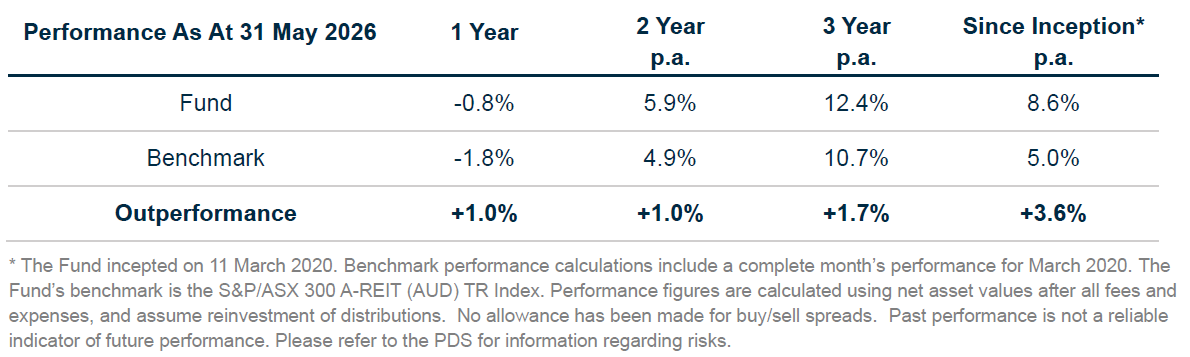
Since inception, the Fund has consistently outperformed its benchmark through disciplined stock selection, active sub-sector positioning and the early identification of structural winners. While markets remain focused on interest rates, inflation and geopolitical uncertainty, we believe the real opportunity lies in the growing divergence between winners and losers within the A-REIT sector.
The proposed CGT and negative gearing reforms could prove a significant catalyst, shifting capital away from direct residential property and high-growth investments towards high-yielding and income-focused investments. Against this backdrop, A-REITs offer a compelling combination of resilient earnings, tangible asset backing, sustainable income and attractive valuations. A-REIT fund investors can continue to enjoy the benefits of income yield not reliant on negative gearing, high liquidity and diversification without having their capital locked up in a single illiquid asset. Our focus remains on preserving capital, generating sustainable income and identifying the next generation of sector leaders before the market fully recognises their value.
Download PDF version here.